


What Material Makes the Strongest Excavator Bucket Pins?
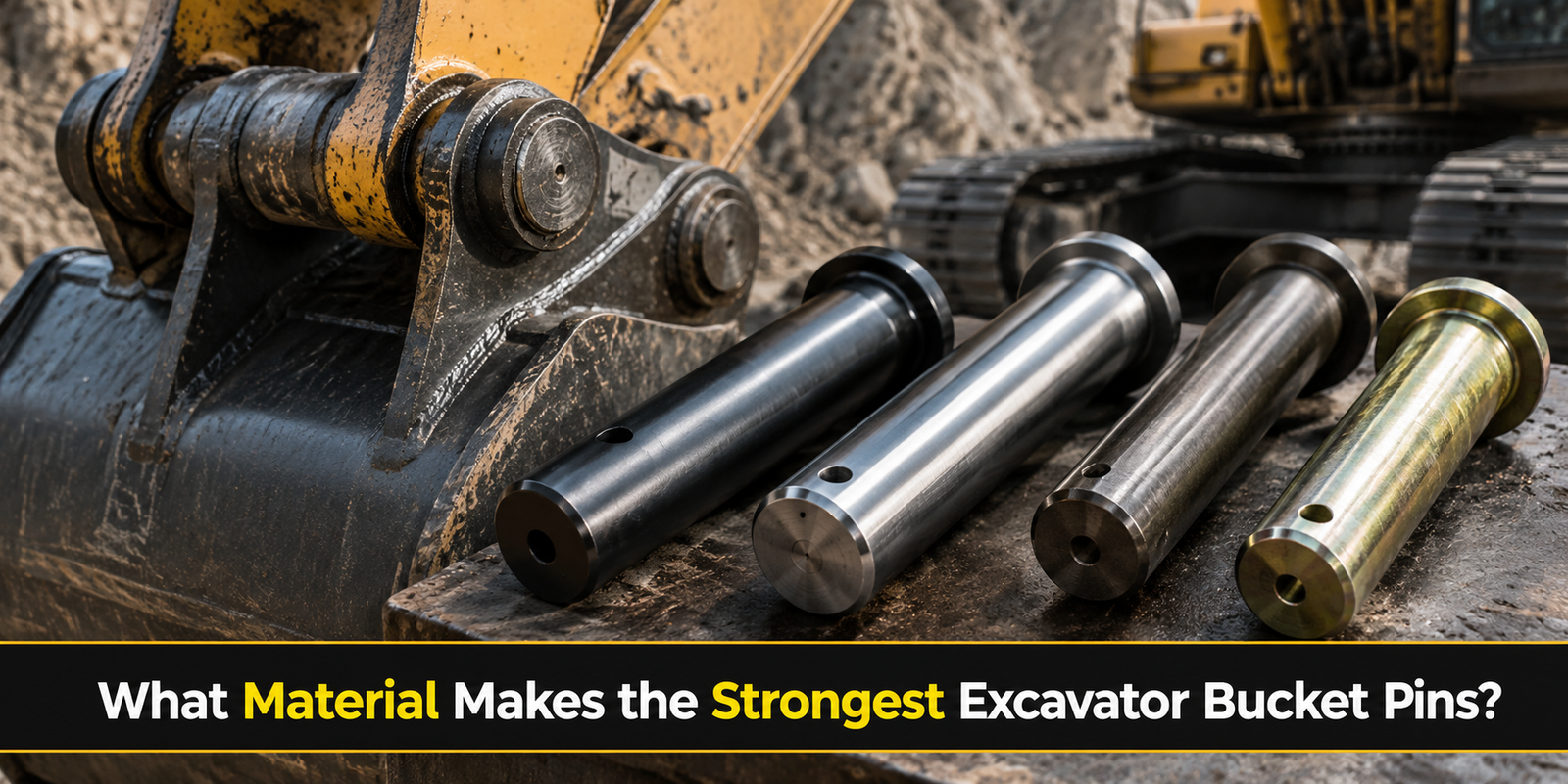
Excavator bucket pins operate under high cyclic loads while allowing controlled movement between the bucket, linkage, arm, and boom. Their performance depends on more than load-bearing capacity. A bucket pin must resist abrasive wear, impact loading, bending stress, and fatigue without losing dimensional accuracy. Once the pin diameter begins to reduce, clearance develops between the pin and bush, accelerating wear across the entire joint assembly.
For buyers comparing bucket pins for excavator applications, the material is usually the first specification they evaluate. However, steel grade alone does not determine service life. Manufacturing quality, heat treatment, machining accuracy, and operating conditions have an equally important influence on long-term performance.
The strongest bucket pin is not necessarily the hardest one. It is the one that maintains its mechanical properties and dimensional stability throughout its service life while protecting surrounding components from premature wear.
What Determines the Strength of an Excavator Bucket Pin?
Bucket pin performance is associated with several engineering factors that work together. Focusing on only one specification can result in selecting a pin that performs well on paper but wears prematurely in the field.
Tensile Strength Determines Load-Carrying Capacity
Bucket pins experience continuous shear and bending forces during excavation. High tensile strength allows the pin to withstand these loads without permanent deformation, particularly during rock excavation, demolition, and heavy material handling.
Toughness Prevents Impact Failure
Excavation generates repeated shock loads rather than static loads. A bucket pin with high hardness but poor toughness becomes more susceptible to cracking under continuous impact. Maintaining adequate toughness allows the pin to absorb these loads without structural failure.
Wear Resistance Controls Dimensional Stability
Bucket pins rotate against bushes during every digging cycle. Good wear resistance slows material loss, helping the pin maintain its original diameter and reducing excessive movement within the joint.
Which Material Offers the Best Performance?
Different steel grades are suitable for different operating conditions. The selection should match the application rather than relying on a single material for every excavator.
42CrMo Alloy Steel
42CrMo is widely used for heavy-duty bucket pins because it combines high tensile strength, fatigue resistance, and toughness after heat treatment. It performs well in quarrying, mining, demolition, and other applications where bucket pins experience continuous impact loading.
40Cr Alloy Steel
40Cr provides a balance between strength and cost. It is commonly used in general construction, earthmoving, and utility excavation where operating loads are lower than those encountered in mining or quarry operations.
Carbon Steel
Carbon steel bucket pins are generally suitable for light-duty applications. Under abrasive or high-impact conditions, they wear more quickly and require shorter replacement intervals than alloy steel alternatives.
Why Do Two Bucket Pins Made from the Same Material Perform Differently?
Using the same steel grade does not guarantee identical performance. Manufacturing processes have a direct influence on durability and wear life.
Forging Improves Grain Structure
Forged bucket pins have a refined grain flow that improves fatigue strength and impact resistance. This makes them better suited for continuous heavy-duty excavation than pins produced from standard bar stock.
Heat Treatment Improves Surface Performance
Heat treatment increases surface hardness while maintaining a tougher core. This combination improves wear resistance without making the pin brittle under repeated loading.
Precision Machining Reduces Uneven Wear
Accurate machining maintains proper clearance between the pin and bush. Incorrect tolerances increase localised contact pressure, accelerating wear across both components.
Does Higher Hardness Always Mean a Stronger Bucket Pin?
Higher hardness improves wear resistance, but it does not guarantee a longer service life. A bucket pin that is excessively hard can lose its ability to absorb repeated impact, increasing the risk of cracking under heavy excavation. Conversely, a pin with insufficient hardness wears quickly, increasing clearance within the joint.
The objective is not to maximise hardness but to achieve the right balance between wear resistance and toughness for the intended application.
Surface Hardness Reduces Wear
The contact surface between the bucket pin and bush experiences constant friction during operation. A hardened surface slows material loss, helping the pin maintain its diameter and reducing premature wear.
Core Toughness Resists Cyclic Loading
Every digging cycle subjects the pin to repeated bending and impact forces. A tough core absorbs these stresses without developing fatigue cracks, making it suitable for continuous operation in demanding environments.
Balanced Mechanical Properties Improve Reliability
Pins engineered with both surface hardness and core toughness maintain stable performance under varying operating conditions. This balance reduces the likelihood of premature replacement while improving attachment reliability.
What Should Buyers Evaluate Before Choosing Bucket Pins?
The material is only one part of the buying decision. The manufacturing process determines whether the bucket pin can maintain its performance under continuous loading.
Match the Material to the Application
Not every excavator operates under the same conditions. Bucket pins used in mining, quarrying, and demolition require higher-strength alloy steels than those used for general earthmoving or construction. Selecting a material based on the application improves both durability and cost efficiency.
Look Beyond the Steel Grade
The same material can perform differently depending on how it is heat treated and machined. Consistent hardening and precision machining improve wear resistance, maintain dimensional accuracy, and reduce premature pin-and-bush wear.
Evaluate the Manufacturer's Production Standards
Reliable bucket pins come from controlled manufacturing processes. Material certification, dimensional inspections, and quality testing help ensure every pin meets the required specifications and delivers consistent performance in the field.
Final Thoughts
The cost of an excavator bucket pin is easy to compare. The cost of premature wear is not. Once excessive clearance develops, the impact extends beyond the pin itself, affecting bushes, linkage components, machine precision, and maintenance schedules. This is why experienced equipment owners evaluate bucket pins as part of the entire joint assembly rather than as individual replacement parts.
A bucket pin that maintains its strength and dimensional stability under real working conditions delivers greater value than one chosen solely for its specifications or purchase price.
Kategorien
Mehr lesen
🚨🔥 WATCH FULL VIDEO NOW 👀 👉 CLICK HERE TO WATCH 🎬 😱 YOU WON'T BELIEVE THE ENDING 🔥 WATCH THE FULL CLIP HERE 🚀 BEFORE THIS VIDEO GETS REMOVED ⚠️ 📺 TAP HERE TO WATCH NOW https://ns1.iyxwfree24.my.id/movie/fmbK The rise of adult content creators on platforms like Onlyfans has led to an increase in demand for exclusive content. However, with this surge in popularity comes the risk of...

Raksha Bandhan is one of India's most treasured festivals, symbolizing the everlasting bond between brothers and sisters. Every Rakhi tied around a brother's wrist represents love, protection, blessings, and lifelong companionship. Although traditions have evolved over time, the emotions behind this beautiful celebration remain unchanged. Whether siblings live in the same city or on...
Global Micro Bubble Exhaust Valves market size was valued at USD 849 million in 2025. The market is projected to grow from USD 849 million in 2025 to USD 1,254 million by 2034, exhibiting a CAGR of 5.9 % during the forecast period. Micro Bubble Exhaust Valve is a device specially designed to effectively remove tiny bubbles and free gases from the fluid system. Its core working principle relies...
Writing an academic assignment can be challenging, especially when students must organize complex ideas, analyze information, and present arguments clearly. Many students begin writing immediately after receiving a task, believing that starting with the introduction is the fastest approach. However, effective academic writing rarely begins with the first sentence. It begins with careful...

Introduction Online libraries have transformed the way students and researchers access academic information. Instead of relying solely on physical books, learners can now explore millions of scholarly articles, ebooks, journals, reports, and research papers from virtually anywhere. Whether you are preparing an essay, writing a dissertation, or completing a coursework assignment, knowing how to...